
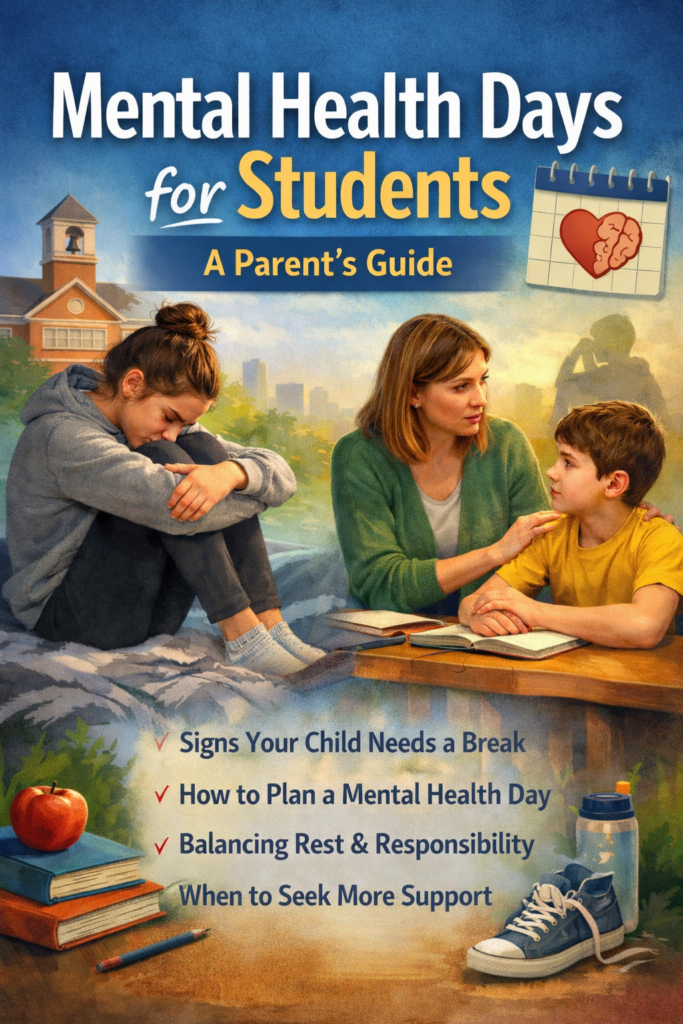
How Do Students Take Mental Health Days?
Mental health days, intentional absences from school that parents allow for a child to make an emotional reset and reduce stress and lack of focus. They are not about responsibility; rather, they are preventive measures that aim to help students regulate their emotions before stress levels cause them to burn out, refuse to attend school, or suffer academically.
In the current educational culture, students are under more pressure academically, socially, and digitally through social media platforms than their parents’ generation, with extracurricular demands and performance expectations. There is no longer a choice not to support student mental health; it is the basis of learning.
The Impact of Poor Mental Health on Academic Achievement
When children are over their heads, their brains assume a stress response of fight-or-flight. This impacts:
- Memory retention
- Concentration
- Emotional regulation
- Executive functioning
- Problem-solving ability
- An out-of-balance student is not going to perform at their best, no matter how academically able.
Studies in neuroscience have repeatedly demonstrated that chronic stress is bad for learning. A well-timed mental health day can break that cycle, restoring equilibrium.
Signs Your Kid Could Use A Mental Health Day
Parents should watch for patterns, not individual complaints. Indicators may include:
- Ongoing fatigue despite adequate sleep
- Tearfulness or irritability before school
- Recurring headaches or stomach pain without any medical cause.
- Increased stress from work or social activities
- Withdrawal from friends or activities
- Difficulty focusing despite effort
- “Seek the help of a pediatrician or mental health clinician if symptoms are ongoing or severe. Mental Health Days: supporting, but not replacing, clinical care where it is needed.
How to Plan an Effective Mental Health Day
A mental health day should be restorative — not just recreational.
Healthy reset activities include:
- Moderate to light rest ( Not like you slept the whole day away)
- Outdoor time for exercise and natural light
- Journaling or reflective conversation
- Creative pursuits such as drawing or music
- Breathing exercises or grounding techniques
- Return to school light planning
- The point is to recalibrate your emotional responses, not to avoid them.
Won’t Mental Health Days Promote Avoidance?
It is a truth universally acknowledged that many parents wonder if allowing their children to take mental health days teaches them to “quit.”
What differs is the structure and tone of their messages.
Reinforce that:
- The day is for healing, not for escaping.
- The process includes a plan to return.
- Responsibilities remain important.
- When considered carefully, the goal of mental health days is to foster self-awareness, emotional literacy, and resilience.
- Avoidance only becomes problematic when absences become so regular and established that they go unaddressed.
How to Talk to Your Child’s School
If your district allows mental health days:
- Follow attendance policies honestly.
- Ask about missed assignments in a non-urgent, non-demanding manner.
- Support a gradual reentry.
- Even if mental health days are not there in name, parents feel they can say their child needed a wellness day.
- Reducing stigma starts with transparency.
- When Mental Health Days Evoke More Than Rest
Excuse after excuse for time off could mean:
- Bullying or peer conflict
- Academic overload
- Learning differences
- Social anxiety
- Depression or generalized anxiety
If mental health days start happening a lot, that is when it might be worth looking into more. Restoring long-term wellness means going after root causes, not just providing temporary relief.
Prioritizing Student Mental Health at Home
Mental health days are most effective when they occur within an entire culture of emotional support. Ways parents can build daily resilience include the following:
- Maintaining consistent sleep routines
- Limiting overscheduling
- Encouraging open emotional conversations
- Modeling healthy stress management
- Creating technology boundaries
- Celebrating effort, not just outcomes
- When children see how adults cope with stress, your example becomes their blueprint.
Mental Health Days and Fair Education
Not all students reported feeling safe disengaging from the school environment.
Fear of falling behind or letting adults down also burdens some children.
Reassure your child that:
- Health and success are not opposed.
- Rest is strategic, not weak.
- They are not valuable only according to their productivity.
- Emotional support should not be a privilege — it should be part of good parenting and schooling.
Final Thoughts
Rest is a Skill, Not a Weakness
Mental health days for students are not an excuse to dumb down standards. They are focused on preserving long-term performance and well-being.
Learning is a marathon, not a sprint.
Helping children learn when and how to pause enables them to develop lifelong skills in emotional regulation, self-awareness, and resilience. Used intentionally, mental health days underscore a powerful reality. It is part of being a responsible adult to take care of your mind.123
- Center on the Developing Child at Harvard University. (2014). Excessive stress disrupts the architecture of the developing brain. Harvard University. ↩︎
- Centers for Disease Control and Prevention. (2023). Youth risk behavior survey data summary & trends report: 2011–2021. U.S. Department of Health and Human Services.
↩︎ - American Psychological Association. (2019). Stress in America™: Stress and current events. ↩︎