
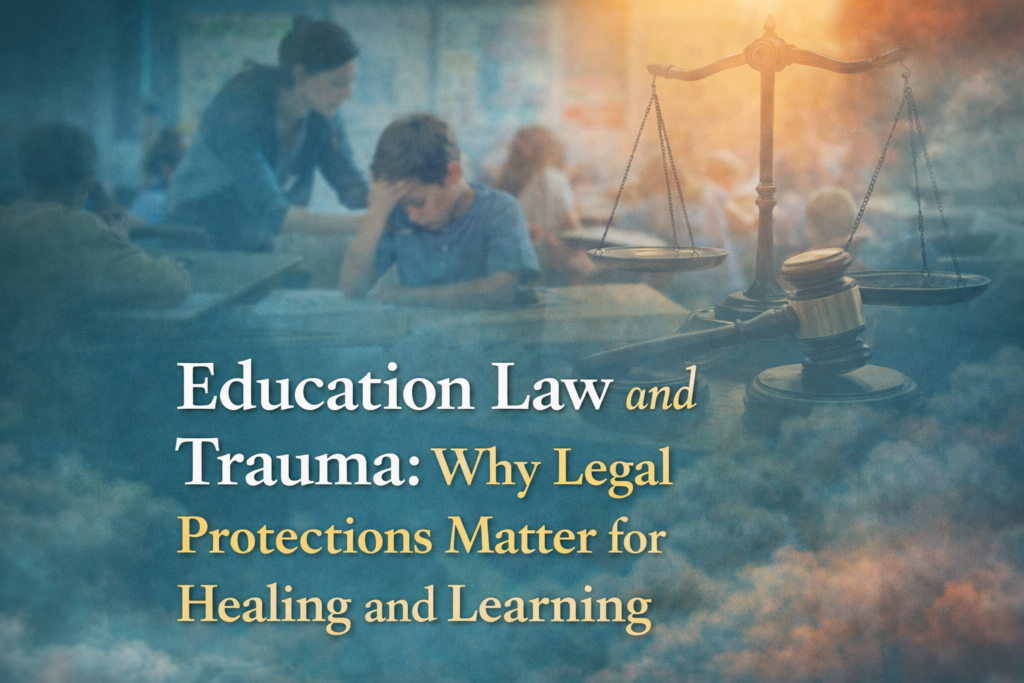
Education Law and Trauma: Why Legal Protections Are Essential for Healing and Learning
Trauma doesn’t check itself at the school door. Traumatic experiences involving abuse, neglect, community violence, displacement, or loss can affect how students learn, right down to how well they do in school. Modern education law is increasingly acknowledging this fact and imposes legal and ethical obligations on schools to facilitate not only academic success but also student health.
Educators, administrators, parents, and advocates need to know how education law intersects with trauma.
How Trauma Impacts Learning
The development and regulation of the brain are influenced by trauma, particularly in regions related to attention, memory, emotional control, and working memory (executive functioning). For the classroom, this might mean:
- Difficulty concentrating or retaining information
- Heightened emotional responses or withdrawal
- Common behavioural issues are mistaken for defiance
- Increased absenteeism or disengagement
- Misunderstanding trauma and the result is that students who need supportive intervention are more likely to receive exclusionary discipline, something education law is supposed to prevent.
What to Know About Education Laws That Protect Traumatized Students
Several federal laws afford protections particularly applicable to trauma-impacted students.
Individuals with Disabilities Education Improvement Act (IDEA)
IDEA guarantees eligible children with disabilities, such as emotional disturbance or other health impairments due to trauma, receive a Free Appropriate Public Education (FAPE).
Under IDEA, schools must:
- Identify and assess students who might need help
- Provide Individualized Education Programs (IEPs)
- Provide services in the most minimal setting possible
- Trauma needs may serve as a basis for a student’s eligibility when they impede learning.
Rehabilitation Act, Section 504
Section 504 safeguards students whose trauma significantly limits one or more major life activities, such as learning, concentrating, or regulating emotions.
Schools are required to:
- Provide reasonable accommodations
- Prevent discrimination based on disability
- Provide peer-equitable access to education
- Unlike IDEA, the Section 504 provision applies even if your student does not need special ed.
Every Student Succeeds Act (ESSA)
ESSA expanded the definition of school success beyond test scores. It emphasizes:
- Student mental health supports
- Safe and supportive school climates
- Evidence-based interventions
- ESSA promotes trauma-informed practices as part of whole-child education.
Title IX
At schools, responses to students who say they have experienced sexual harassment or assault are supposed to be quick and equitable under Title IX.
Trauma-informed investigations and supports are essential to staying in compliance and helping students recover.
Laws, Imperatives, and Professional Norms: Creating Trauma-Informed Schools
Trauma-informed education is not simply best practice—it is in keeping with legal obligations.
A trauma-informed school:
- Acknowledges the prevalence and impact of trauma
- Avoids re-traumatization through harsh discipline
- Uses restorative and supportive approaches
- Trained staff to be empathetic and structured
- Punishing discipline that denies students support, especially if their behavior is connected to a documented disability or mental health need, might infringe on the rights of a student
Discipline, Equity, and the Law
Studies repeatedly show that traumatized students — especially children of color and those in foster care — are disciplined at higher rates. Education law increasingly scrutinizes:
- Suspensions and expulsions
- Discriminatory impact of discipline policies
- Failure to consider disability-related behavior
- Schools need to ensure that their policies and practices are fair, legally defensible, and developmentally sound.
What Schools Can Do Now
To be in accordance with the education law and help students facing trauma, schools must:
- Provide trauma-informed training for all staff
- Foster more partnerships between educators, counselors, and families
- Ensure the discipline policy complies with the law and equity
- Data to identify patterns of exclusion or harm
- Focus on mental health and early intervention
Conclusion
Education law acknowledges what is already established in neuroscience and well known from lived experience: When students do not feel safe, supported, and understood, they cannot learn effectively. Trauma-informed practices are not optional—they are part of meeting the legal promise of equitable education.
To the extent that schools honor both the law and students’ lived experiences, they can promote environments where healing and learning co-occur.1
- Individuals with Disabilities Education Act, 20 U.S.C. § 1400 et seq. (2004).
Rehabilitation Act of 1973, Section 504, 29 U.S.C. § 794 (1973).
Every Student Succeeds Act, Pub. L. No. 114–95, 129 Stat. 1802 (2015).
Education Amendments of 1972, Title IX, 20 U.S.C. § 1681 (1972).
↩︎